
.webp)







.jpg)


A Smarter Path to Help Prosecute Offenders: Why Choose Flock’s Mobile Security Trailer vs LVT?
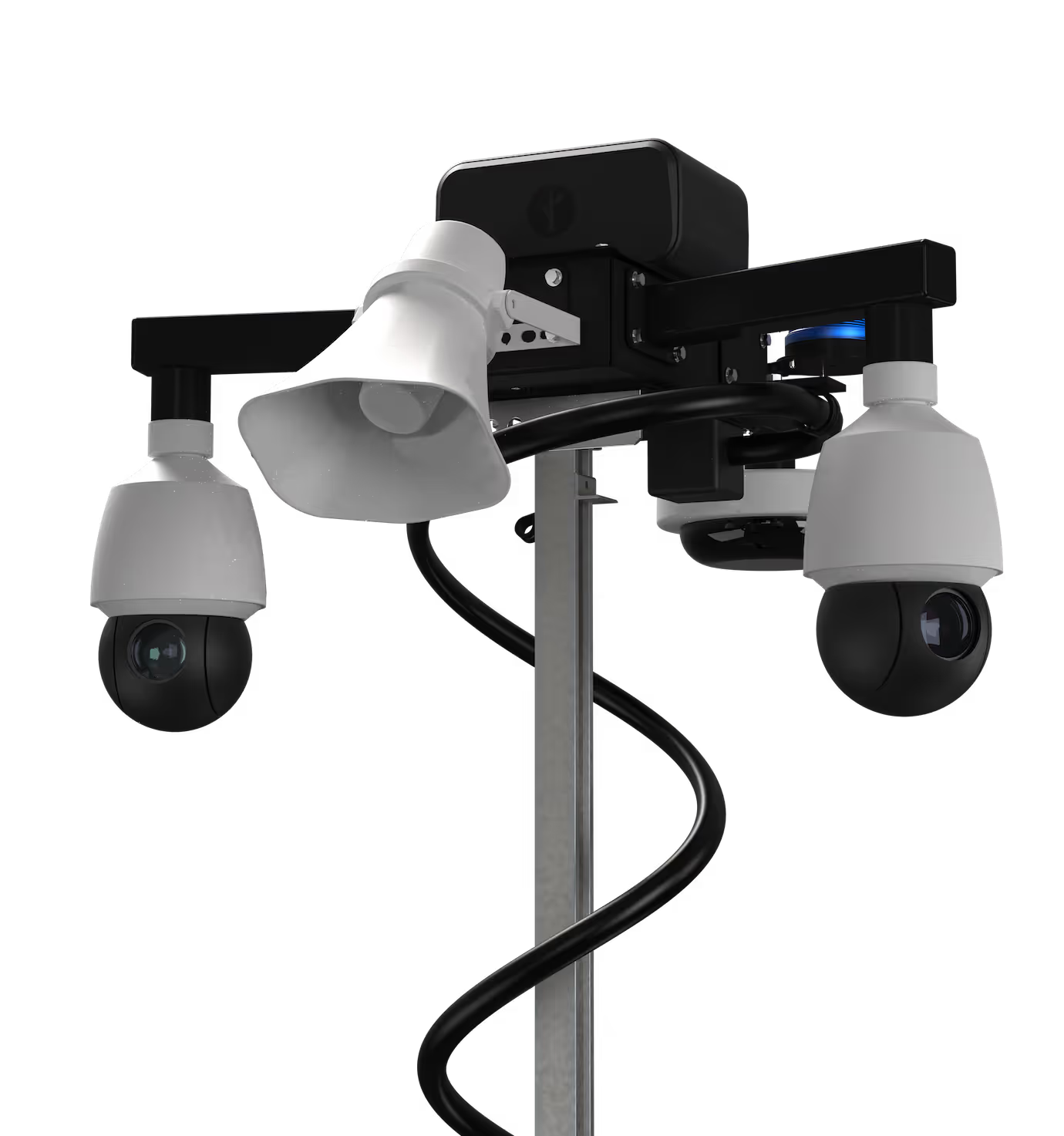
Flock’s mobile security trailer goes beyond deterrence by connecting into a unified platform that helps organizations capture usable evidence, identify offenders, and support case resolution.

Criminals strike where oversight thins out. They gravitate to loading zones, side entrances, and remote corners where visibility drops and opportunity rises.Consider a busy distribution yard on a weeknight. Trucks arrive after dark, employees are stretched between tasks, and blind spots multiply as shipments move in and out. In the middle of that activity, a person waits for the right moment to steal tools, cut open a pallet, or slip merchandise into a vehicle. When there’s little usable evidence, losses become routine operating costs instead of solvable cases.
Many organizations turn to mobile security trailers as their first line of defense. They’re fast to deploy, highly visible, and can provide coverage exactly where incidents occur. But visibility alone isn’t enough, and it’s where the gap between mobile security trailer solutions becomes clear. Some trailers deter crime, but don’t deliver the intelligence needed to close cases. Others depend on live monitoring or manual review, forcing teams to request and wait for footage, which slows response times and investigations.
Flock’s mobile security trailer isn’t just a standalone deterrent. It plugs into a connected security ecosystem that helps prevent incidents, spot suspicious activity, capture usable evidence and share it instantly with law enforcement. By contrast, LiveView Technology (LVT) offers standalone trailers that stop at deterrence. They lack the investigative tools, evidence management capabilities and seamless law enforcement collaboration that a connected ecosystem provides.
A Platform Approach: Unified Ecosystem vs. Standalone Trailer
One of the most important differences between the two solutions is Flock’s unified security platform. Flock provides an end-to-end ecosystem that unifies mobile security trailers, license plate readers, additional video cameras, drones, and audio detection, all accessible through a single interface. This allows organizations to see activity across their property, connect signals from multiple devices, and conduct investigations end-to-end in one platform, without switching tools, vendors, or systems, streamlining operations and eliminating vendor sprawl.
LVT, by comparison, primarily offers solar-powered surveillance trailers with live monitoring ability. LVT relies heavily on third-party integrators for features beyond basic video capture, creating a fragmented operating environment for security teams.
Crime Solving vs. Deterrence: Evidence That Drives Outcomes
This separation becomes especially apparent when an incident occurs. Flock is built to help teams not only deter and document unwanted activity, but also get the evidence needed to close cases. The platform combines video, license plate data, and powerful search tools that help identify suspects and provide the evidence law enforcement needs to move a case forward. Teams can review footage, filter activity, and export evidence immediately, unlike LVT, where users must submit requests and wait for processing.
LVT’s trailers, while highly visible, are optimized for deterrence and live monitoring. They may help discourage misconduct, but without LPR or advanced investigation tools, teams may not be able to identify who was actually responsible. In today’s environment, deterrence alone isn’t enough. Organizations need technology that supports real investigative outcomes.
Total Cost of Ownership: Transparency vs. Stacked Fees
Cost is another area where the two solutions diverge. Flock’s pricing model is designed to be transparent and predictable, helping organizations plan for long-term needs and avoid unexpected add-ons. Whether you’re deploying a single trailer or expanding across multiple sites, your costs remain easy to understand.
LVT’s pricing becomes unpredictable as add-on fees accumulate, such as cellular fees for data overages. What initially appears affordable can become challenging to forecast, creating uncertainty for budget-conscious teams.
Vendor & Support Model: One Partner vs. Many
The difference extends into support as well. Flock operates through a direct-to-customer model, meaning the same company that provides your trailer also provides your installation, platform support, and ongoing service. This eliminates the confusion of dealing with multiple vendors and ensures you have one accountable partner.
With LVT, trailers are often sold and supported through channel partners or integrators, each with their own contracts, SLAs, and communication processes. This results in inconsistent service and uncertainty around who owns an issue when something breaks. Having one partner simplifies everything, especially when evidence or uptime is critical.
User Experience & Access to Evidence: Instant vs. Request-Based
Ease of use is another major differentiator. Flock’s intuitive platform enables operators to quickly view, search, and export evidence for streamlined collaboration with law enforcement. This immediate access is critical during investigations, where time-sensitive decisions depend on clear, actionable information.
With LVT, footage retrieval often requires submitting a ticket request and waiting hours. Those delays can hinder active investigations, especially when collaborating with law enforcement before a suspect or vehicle leaves the area.
AI & False Alarms: Signal vs. Noise
Alerting and noise reduction also influence the overall effectiveness of a security trailer. Flock’s AI reduces false alarms, helping teams focus on meaningful threats rather than wading through unnecessary notifications. This approach keeps operators and monitoring partners more effective.
LVT’s AI alerts are known for high false-positive rates, overwhelming operators with noise and leading to missed activity. Too much noise weakens response and, over time, reduces trust in the system.
Law Enforcement Collaboration: Purpose-Built vs. Secondary
Flock was designed from day one to support collaboration with law enforcement. Evidence sharing is controlled, auditable, and simple to use, ensuring that relevant information reaches the right people quickly and securely. This is because Flock was built with investigative workflows at its core, not added later as an afterthought.
LVT, while useful for deterrence, places less emphasis on law enforcement workflows and investigative use cases. For organizations seeking meaningful outcomes and case resolution, this difference is substantial.
Seamless Expansion: Growth Through Intelligence vs. Hardware Add-Ons
Finally, Flock offers greater long-term flexibility as your security needs evolve over time and across locations. Because the trailer operates as part of a larger ecosystem, organizations can start with a single trailer and expand to license plate readers, audio detection, drones, and more, without changing systems or retraining staff.
LVT’s model primarily scales by adding more trailers, not by increasing intelligence. That means expanding coverage often becomes more expensive and less efficient over time.
Choose a Trailer That Delivers Outcomes, Not Just Optics
Mobile security trailers should deliver more than a visual deterrent. They should help you understand what happened, identify who was responsible, and get the actionable evidence needed for investigations. LVT provides real-time visibility. Flock delivers the evidence organizations need to close cases.
For organizations serious about holding offenders accountable, Flock’s mobile security trailer delivers a smarter, more future-ready foundation for real crime reduction.


Protect What Matters Most.
Discover how communities across the country are using Flock to reduce crime and build safer neighborhoods.