
.webp)







How to Build a DFR Program for Smaller Agencies
This practical guide explains how smaller law enforcement agencies can use Drone as First Responder programs to get faster information, manage limited staffing, and improve safety without a big-city budget.

Why Drones Matter More for Smaller Agencies Than You Might Think
For many law enforcement agencies, drones can sit in an uncomfortable middle ground. They are widely recognized as a valuable tool for law enforcement and are frequently discussed, yet they are often viewed as a capability reserved for large, well-funded agencies. That perception has kept many smaller departments from moving forward with building their own Drone as First Responder (DFR) program.
The reality is that agencies with 100 or fewer sworn officers are often the ones that stand to gain the most from a well-designed DFR program. When staffing is thin, backup is limited, and every call pulls a significant percentage of patrol off the street, having early, accurate information can make the difference between an efficient response and unnecessary risk. Modern DFR Programs focus on speed, prioritization, and more intelligent use of existing resources.
This article is designed to help police chiefs and sheriffs understand how to build a DFR program that fits a smaller agency’s reality. It explains the benefits, addresses common challenges, and outlines practical steps to get started without replicating a big-city model.
Debunking the Myth That Drones Are Only for Large Agencies
One of the most persistent myths in public safety is that effective DFR programs require a large Real-Time Crime Center, a team of full-time pilots, and a helicopter-sized budget. That belief is outdated. Advances in automation, system integration, and remote operations have significantly lowered the barrier to entry. Smaller agencies often feel staffing shortages more acutely, which makes the efficiency gains from drones even more impactful. A drone that can quickly confirm what is actually happening on a call can prevent unnecessary responses, reduce officer exposure, and free up limited units for higher-priority work.
Understanding Traditional Drone Programs vs. Drone as First Responder
Before building a program, it is important to understand the difference between traditional drone operations and Drone as First Responder. Traditional drone programs typically deploy a drone after officers arrive on scene. The drone is often launched from a patrol vehicle or station and flown by an officer who is already managing a call, radio traffic, and scene safety. These programs can be useful, particularly for planned or high-risk incidents, but they tend to be reactive and infrequently used.
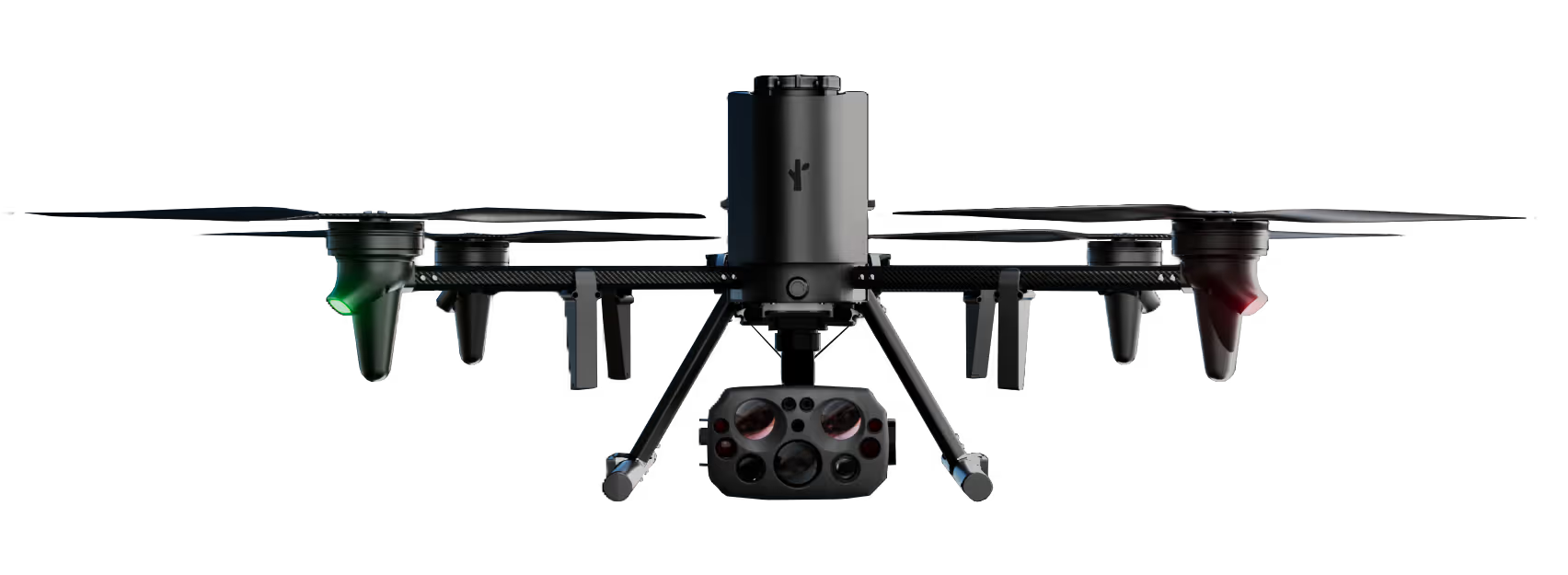
DFR takes a fundamentally different approach. Drones are pre-positioned and ready to launch immediately upon receiving a call for service or when specific alerts are triggered. The drone often arrives before ground units, providing early situational awareness that shapes the response from the very beginning. This early arrival is what separates DFR from traditional patrol-led drone use. Importantly, successful DFR programs are not about random patrol or constant surveillance. They are incident-based, transparent, and directly tied to calls for service.
The Operational Benefits of Drones for Smaller Agencies
For smaller agencies, the benefits of a DFR program extend well beyond technology. Faster response is the most obvious advantage. Drones travel as the crow flies and are not delayed by traffic, distance, or the need for additional units to respond. That speed provides supervisors and officers with critical information early, often before decisions are finalized. Awareness of what officers are driving into reduces uncertainty and enables safer approaches.
Drones also function as a force multiplier. Agencies across the country are resolving a meaningful percentage of calls using drone response alone, without ever sending officers to the scene. For a small department, clearing even a fraction of calls this way can dramatically improve patrol availability. Early aerial confirmation also enables better decision-making by command staff, allowing them to scale responses appropriately, downgrade resolved calls, or cancel unnecessary units.
Priorities and the Staffing Challenge
Despite these benefits, smaller agencies often hesitate because of staffing concerns. The assumption is that there simply are not enough people to support a DFR program. In practice, the issue is rarely a lack of personnel but rather a question of priorities. Agencies already have people assigned to various roles based on historical needs. The mistake many departments make is treating drone operations as a collateral duty. When pilots are expected to fly while also handling patrol responsibilities, the program loses the speed advantage that makes it valuable.
A more effective approach is to dedicate coverage during the busiest part of the day, even if that coverage is limited to an eight- or ten-hour block. During that time, the pilot’s sole responsibility is monitoring calls and launching the drone. This does not require new hires. It requires reassigning one position to focus on early response. Over time, those initial pilots become subject matter experts who can train others and help the program scale.
Understanding Cost and Return on Investment
Cost is another common concern. Chiefs and sheriffs are often asked to justify why a DFR Ppogram is worth the investment. The return on investment, however, is not found in the aircraft itself. It is found in what the drone prevents from happening. When routine calls are resolved early, fewer officers are tied up unnecessarily. When situations are clarified from the air, foot pursuits, perimeter searches, and escalations are reduced. Preventing even a single major incident or lengthy investigation can offset years of program costs.
Building Community Trust Through Transparency and Clear Policy
Community trust is also a critical consideration. Most public concern around drones stems from uncertainty about how they will be used. Agencies that struggle in this area often fail to clearly define boundaries or communicate purpose. Programs that succeed are explicit about tying drone use to calls for service, avoiding random patrol, and implementing clear privacy protections. Transparency is not a one-time announcement but an ongoing practice that reinforces trust as the program matures.
Step One: Define a Mission That Solves Real Problems
Building a DFR program that fits a small agency starts with defining a clear mission. Leaders should look at call-for-service data and identify where early information would have changed outcomes. These insights should drive how the drone is used and which calls are prioritized. A clearly defined mission keeps the program focused and prevents it from becoming a solution in search of a problem.
Step Two: Establish Clear Leadership Ownership
Strong leadership ownership is the next essential step. Successful programs have an executive sponsor who removes barriers, aligns stakeholders, and maintains consistent messaging internally and externally. This leadership role is not about managing daily operations but about ensuring the program has the authority and clarity it needs to function effectively.
Step Three: Build Policy Around How You Actually Operate
Policy development should reflect operational reality. Policies must describe how the program actually runs during real calls, including who authorizes launches, when drones disengage, and how data is handled. Clear policy gives dispatchers, supervisors, and pilots the confidence to use the tool without hesitation.
Step Four: Start Small, but Be Intentional
Agencies do not need to launch with full coverage on day one. Starting small is appropriate, but starting seriously is essential. A controlled rollout with dedicated pilots, defined hours, and a focus on speed allows agencies to build experience and demonstrate value quickly. Early success creates the momentum needed for expansion.
Step Five: Measure Outcomes That Matter to Leadership and the Community
Finally, agencies should measure what matters. Counting flights or hours in the air does not tell the story. Leaders should track how often drones arrive before officers, how frequently aerial information changes decisions, how many calls are cleared or downgraded, and how patrol resources are impacted. These outcomes resonate with city managers, councils, and the community.
Final Thought: Get Better Information to Decision-Makers Faster
At its core, a DFR program is not about drones. It is about getting better information to decision-makers faster. For smaller agencies, that advantage can translate into safer responses, smarter use of limited staffing, and a patrol division that feels supported even when resources are stretched thin. Drones are not just for large agencies. When implemented thoughtfully, they are one of the most practical tools smaller departments can adopt today.


Protect What Matters Most.
Discover how communities across the country are using Flock to reduce crime and build safer neighborhoods.