
.webp)








How To Choose the Right Mobile Security Trailer
Learn How to Choose a Mobile Security Trailer by Comparing Platform Integration, AI Detection Quality, Deployment Fit, and Subscription Pricing

Mobile security trailer buyers usually understand the basics: solar power, cameras, and a movable unit. The harder question is how to evaluate platform fit, integrations, and pricing before committing to a subscription. What you need is a way to separate standalone hardware from connected platforms, with a framework for evaluating features, integrations, and pricing before you commit to a subscription.
Here's the core tension most buyer guides skip: most trailer providers sell a standalone piece of hardware. It records video and supports deterrence, but the value is limited when the data stays siloed. The right choice isn't just a trailer. It's a platform that connects that trailer to vehicle intelligence, evidence workflows, and law enforcement sharing. This guide gives you a structured way to evaluate vendors, features, and deployment fit against that standard.
Key Takeaways
- Choosing a mobile security trailer means choosing a platform. Siloed hardware generates video, while a unified ecosystem connects trailers to vehicle intelligence and investigations.
- Native license plate reader camera integration should be a core buying criterion when vehicle evidence is part of the deployment.
- AI detection quality directly affects operational costs. High false positive rates create alert fatigue and can erode trust in the system over time.
- Site assessment before purchase helps buyers match trailer capabilities to hotspot mobility, coverage area, and hours of vulnerability specific to their environment.
- An all-in subscription should bundle hardware, LTE, storage, and software in one predictable line item, with no hidden monitoring or analytics fees added later.
Platform Vs. Trailer
Before comparing camera specs or battery life, it's worth establishing the frame you'll use to evaluate everything else in this guide: a trailer is hardware. A platform connects that hardware to vehicle intelligence, real-time alerts, and investigative workflows. That distinction should anchor your evaluation alongside deployment speed and cost.
Treat this as the lens for every feature criterion that follows. Does this vendor offer a platform, or just a trailer?
Why Siloed Hardware Limits Your Outcomes
A trailer operating as a standalone unit generates video, but it may not provide actionable vehicle evidence, customer-configured hotlist alerts, or a direct workflow for investigative follow-up. It records what happened, but it may not help you act on that information afterward.
The operational consequence shows up downstream. Investigators working with a siloed trailer have to manually pull footage, cross-reference vehicle data from separate systems, and export evidence without any shared workflow tying it together. Each step adds time when investigators need clear evidence and fast coordination.
The Unified Ecosystem Advantage
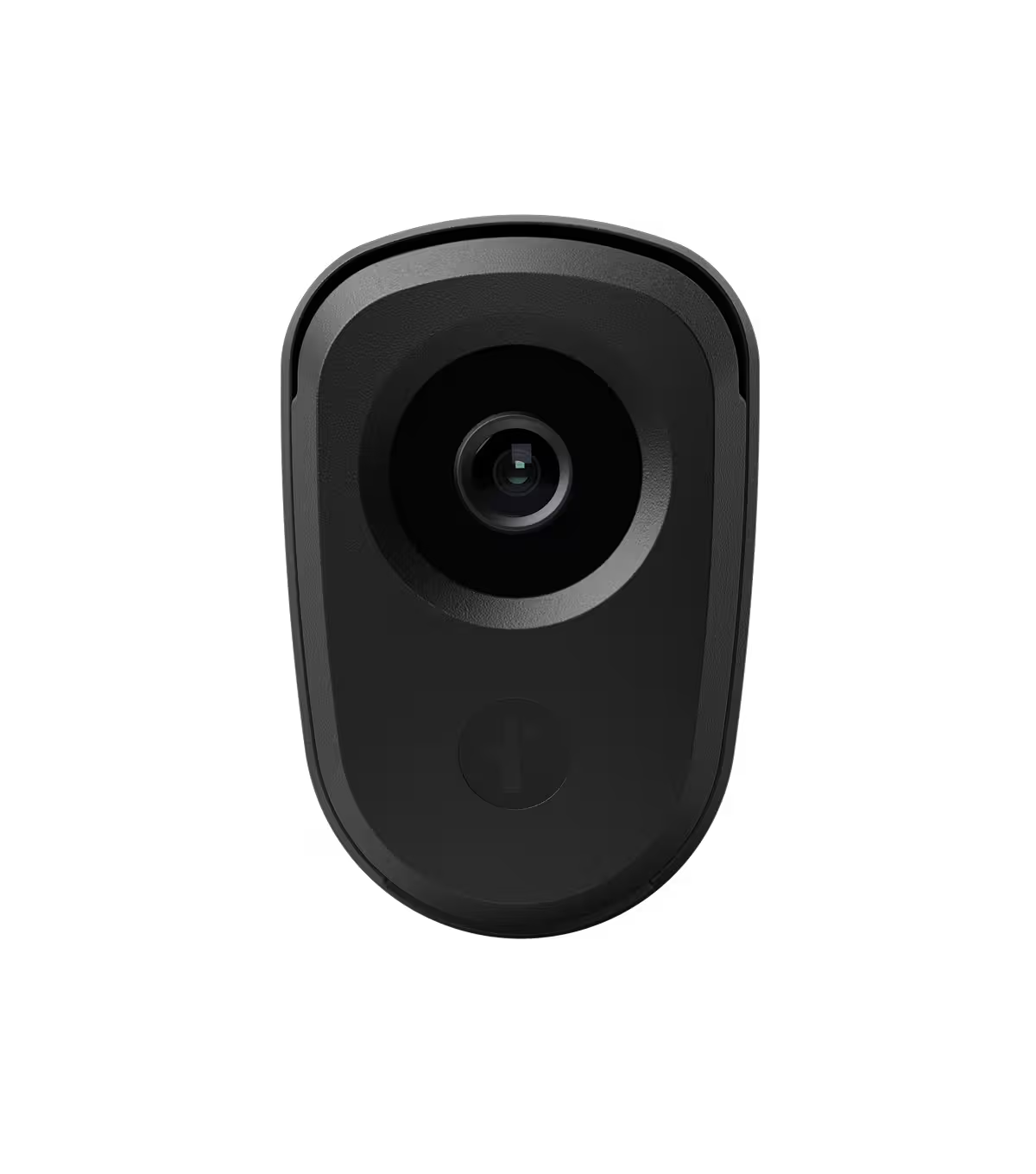
Flock mobile security trailers feed directly into a unified platform alongside license plate reader cameras, video cameras, and audio detection. That means a trailer deployed at a parking lot last month is part of the same searchable network as the fixed cameras covering your main entrance.
Flock FreeForm lets investigators run plain-language searches across connected video and LPR data to surface relevant leads faster in the same platform. If you're evaluating a vendor's platform claims, this is a concrete capability to ask them to demonstrate, not just describe.
Core Hardware Features Every Trailer Needs
Once the platform question is settled, hardware still matters. Every mobile security trailer should be evaluated against five hardware requirements: 360-degree camera coverage, reliable solar power, weather resistance, cellular connectivity, and visible deterrence.
PTZ and Panoramic Camera Coverage
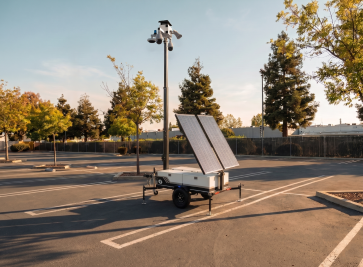
Flock trailers include two pan-tilt-zoom (PTZ) cameras and one panoramic camera, giving you 360-degree outdoor coverage from a single unit. That combination matters because wide coverage and identifying detail are usually a trade-off: panoramic cameras capture the full scene, while PTZ cameras zoom in for detail, and you need both working together.
Guardian Mode automatically directs the PTZ camera when a person or vehicle enters the camera’s field of view, capturing closer scene detail without requiring an operator. It helps maintain coverage even when no one is actively monitoring the camera, and it can be configured to run on a set schedule.
Cellular connectivity and visible deterrence, including flashing lights and a talk-down speaker, round out the hardware baseline. Both are standard requirements for a unit that needs to operate without fixed site infrastructure.
Solar Power and Weather Resistance
Sites without electrical service, such as construction yards, utility infrastructure, and remote lots, depend on reliable onboard power for continuous coverage. Solar power isn't a convenience feature here; it's a buying requirement. If a site can't support a hardwired camera system, it can't support a trailer that needs frequent battery swaps either.
Weather resistance follows the same logic. A trailer that needs to be pulled offline during storms or extreme temperatures isn't providing the continuous coverage the deployment was meant to solve for in the first place.
LPR Integration as a Buying Criterion
License plate reader (LPR) camera integration is not a secondary feature to check off. It should be a core criterion when vehicle evidence is part of the deployment. A trailer without it generates video, but it doesn't generate searchable vehicle intelligence from plates and vehicle attributes.
From Deterrence to Evidence
The full workflow looks like this: visible deterrence can discourage activity in the first place. If an incident occurs anyway, LPR data and trailer video combine in one platform for rapid evidence export and customer-authorized law enforcement sharing.
It's worth being precise about what this does and doesn't claim. A mobile security trailer doesn't guarantee an incident will be prevented or stopped. What it offers is deterrence, plus clearer evidence and faster investigative follow-up when deterrence doesn't hold.
AI Detection Quality and Footage Access
Hardware and LPR integration only matter if the alerts they generate are worth acting on. Poor AI detection quality has a real operational cost: high false positive rates create alert fatigue, waste dispatch resources, and erode trust in the system over time.
Flock FreeForm is a concrete example of plain-language search alongside additional alerting built for investigative specificity, rather than generic motion detection that flags anything that moves.
False Positives Cost More Than You Think
Generic motion detection is a known weak point across the category. Systems that aren't tuned for outdoor, after-hours environments trigger on animals, wind, and shifting shadows, generating alerts that require human review but yield no actionable result.
Assessing Your Site Before You Buy
The right trailer configuration depends heavily on where and how it will be deployed. Before you finalize a purchase, map out coverage area, entry and exit points, blind spots, and how frequently your hotspot locations shift.
Coverage Area, Layout, and Hotspot Mobility
If your organization manages sites where problem areas shift over time, such as a parking lot with recurring theft in different areas or a property with seasonal risk changes, redeployment matters as much as initial placement. Buyers managing shifting hotspots need confirmation that a unit can be moved and operational quickly at a new location, with minimal infrastructure work and any required approvals handled before deployment.
Configurable detection zones and active hours illustrate this well: a property manager can focus alerts around when a specific area is actually vulnerable, such as after-hours in a parking structure, rather than running blanket coverage around the clock. For a deeper look at where trailers perform best by site type, see best places to use mobile security trailers.
Short-Term Events Vs. Shifting Long-Term Deployments
These are two different problems with two different requirements. Short-term events, such as a construction milestone, a seasonal retail period, or a one-time gathering, need rapid setup and teardown. Long-term shifting deployments need a vendor that supports redeployment as risk patterns change over months or years.
Make this a direct vendor question rather than an internal planning note: how is redeployment handled logistically, and does the subscription accommodate location changes without additional fees? The answer tells you a lot about whether you're buying a flexible platform or a fixed asset.
Deployment Scenarios Across Industries
Trailer requirements shift depending on who's deploying them and why. Here's how the calculus changes across four common scenarios.
Law Enforcement: Force Multiplier at High-Crime Locations
Agencies deploying trailers to repeat-call locations and problem properties can gain added context before officers arrive on scene, helping responding units approach with better information about what may be happening.
Construction Sites: Perimeter Alerts Without Fixed Wiring
Construction sites are a natural fit for solar-powered, infrastructure-light deployment, with no fixed wiring and less dependence on utility buildout. Loiter alerts add a layer of specificity here: they can notify teams when a person remains in frame past a preset time, which is directly relevant to after-hours perimeter breaches on active job sites where equipment and materials are common theft targets.
Retail and Commercial Property
Parking lots and perimeter areas around retail and commercial properties benefit from combining visible deterrence with LPR-driven vehicle intelligence, particularly for organized retail crime patterns involving repeat vehicles. For a closer look at this deployment type, see mobile security trailers for parking lots.
Multifamily and Municipal Properties
Residential communities and public spaces both need flexible, clearly governed coverage that can move with seasonal risk, such as package theft, shared-lot break-ins, or event-driven crowds, without a permanent installation tying the unit to one location.
Subscription Pricing: What Should Be Included
Pricing evaluation is a total-cost question, not a line-item comparison. The question that matters isn't "what does this cost today." It's "what's included, and what starts getting billed separately as the deployment scales."
Hardware, LTE, Storage, and Software Bundled
A complete, all-in subscription should cover each major cost category in one predictable line item:
- Hardware
- LTE data
- Video storage
- Software access
- AI analytics
- Maintenance
- Customer support
Use this checklist in vendor conversations: confirm that each of these categories is covered before signing. Gaps in coverage are exactly where budget surprises show up after deployment, once you're already committed. For a more detailed breakdown of the buy-versus-lease decision itself, see mobile security trailer cost: lease vs. buy.
Choose a Platform, Not a Trailer
By this point, the evaluation framework is clear: platform integration, searchable footage access, AI detection quality, and transparent subscription pricing. If a vendor falls short on any of these criteria, identify the operational gap before it becomes a workaround during an investigation.
If you're evaluating vendors right now, the fastest way to see how these criteria play out in practice is to walk through a live deployment. To understand how the full picture comes together for your specific sites and use cases, learn more about the value trailers deliver as part of a unified platform in mobile security camera trailer benefits, or book a demo to see the platform in action.
FAQs
What features should I look for when choosing a mobile security trailer?
Prioritize PTZ and panoramic camera coverage, solar power, cellular connectivity, and visible deterrence capabilities like flashing lights and a talk-down speaker. AI-powered detection that reduces false positives matters as much as the hardware itself. License plate reader camera integration has become a core criterion, not a bonus, for deployments where vehicle intelligence and investigative follow-up are part of the outcome.
How important is license plate reader integration for a mobile security trailer?
Native license plate reader (LPR) camera integration is central to the value a trailer delivers beyond visible deterrence. Without it, a trailer generates video but no searchable vehicle intelligence, no customer-configured hotlist alerts, and a less direct path to investigative follow-up. Trailers that feed LPR data into a unified platform connect deterrence to investigation-ready evidence in a single workflow.
What should be included in a mobile security trailer subscription or service plan?
A complete subscription should bundle hardware, LTE data, video storage, software access, AI analytics, and maintenance support in one predictable line item. Vendors that separate monitoring, AI features, or evidence access into add-on fees may create budget surprises after deployment. Confirm what each cost category covers before signing, especially if your deployment spans multiple sites or shifts locations frequently.
How quickly can a mobile security trailer be deployed and moved to a new location?
Mobile security trailers are designed for flexible deployment, reducing the need for fixed wiring or network buildout at the destination site. Solar power and cellular connectivity mean a unit can go operational at a new hotspot without waiting for electrical or fiber installation. For organizations managing shifting crime patterns, redeployment flexibility is a practical buying criterion worth confirming directly with any vendor.
What questions should I ask vendors before choosing a mobile security trailer provider?
Ask whether the subscription covers hardware, LTE, storage, and AI in one line item, or whether those are billed separately. Ask how investigators access and export video, specifically whether retrieval is self-serve or requires a vendor-side clip request. Ask whether LPR camera integration is native to the platform or a third-party workaround, who owns the LPR data, how long it is retained, and how searches are governed, documented, and audited after deployment.


Protect What Matters Most.
Discover how communities across the country are using Flock to reduce crime and build safer neighborhoods.