
.webp)







Assessing the Accuracy of Computer Vision Methods for Traffic Data Collection
An independent field evaluation found Flock Safety’s computer vision based traffic counting achieved 96% vehicle count accuracy, outperforming Caltrans’ induction loop detectors in real-world conditions.
.avif)
Key Results


Accurate traffic volume and vehicle classification data are essential for transportation planning and roadway safety analysis. Traditional traffic counting methods, including in-pavement induction loops and short-duration manual counts, remain widely used but are limited by installation constraints, maintenance demands, and restricted temporal coverage.
The Challenge: Limitations of Conventional Traffic Counting Methods
Reliable traffic data underpin a wide range of transportation engineering activities, including capacity analysis, infrastructure investment prioritization, and roadway safety assessment. While pneumatic tubes, induction loops, radar sensors, and manual field observations have supported planning practice for decades, they present persistent challenges related to installation and maintenance costs, worker safety exposure, limited temporal coverage, and reduced transparency in how traffic counts are produced.
Induction loop detectors are sensitive to pavement condition and calibration drift, while manual counts are labor-intensive and expose personnel to roadside hazards. As transportation planning increasingly depends on consistent, high-resolution measures of traffic exposure, these limitations become more pronounced.
The Solution: Utilization of Computer Vision–Based Traffic Monitoring
Recent advances in computer vision enable non-intrusive, continuous traffic monitoring; however, transportation agencies continue to require empirical validation before adoption. This study addresses that need by evaluating the accuracy and operational performance of a video-based traffic counting system under real-world conditions.
The field evaluation was conducted on E. Kettleman Lane, a multi-lane arterial corridor in San Joaquin County, California. The study segment connects directly to State Route 99 and includes signalized intersections at both ends, as well as multiple commercial access points along the corridor — features that introduce turning movements, lane changes, and variable vehicle speeds that are known to challenge in-pavement detection technologies.
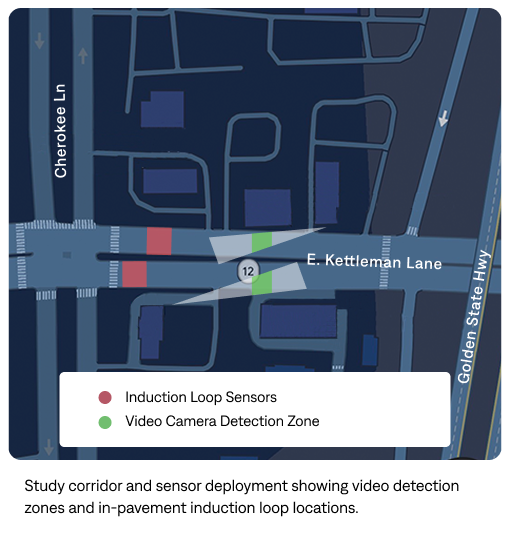
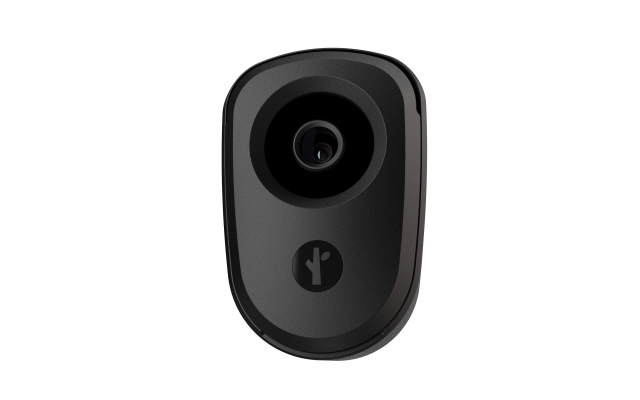
Two solar-powered Flock Safety video cameras, installed by Lodi, CA PD in February 2025, were deployed to monitor eastbound and westbound traffic. The cameras recorded continuous video and generated automated vehicle counts and classifications by travel direction. For comparison, traffic volume data from existing Caltrans induction loop detectors were obtained for the same roadway segment and time periods.
Observation Periods
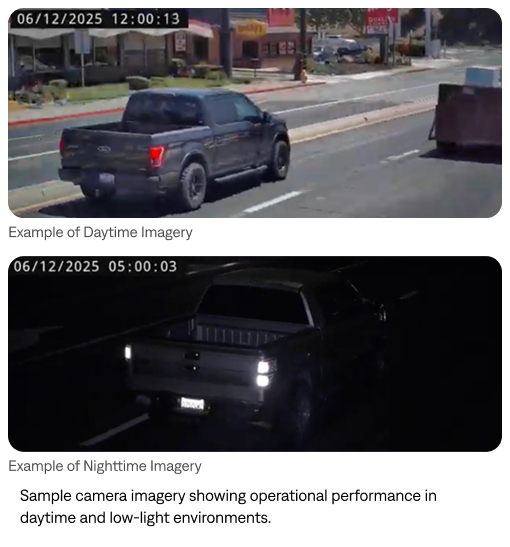
Data were collected on June 12, 2025, during three one-hour periods selected to capture varied lighting and traffic conditions: 5:00–6:00 AM (low-light), 12:00–1:00 PM (midday), and 8:30–9:30 PM (dusk). Both travel directions were observed during each period, resulting in a total of six hours of analyzed traffic data.
To establish a validated reference dataset, six hours of video footage were independently reviewed by multiple trained annotators. Automated video-based counts and Caltrans loop detector data were aggregated into comparable 15-minute and hourly bins.
The Results: Flock Safety Cameras Achieve 96% Vehicle Count Accuracy Against Annotated Reference Data
Across all observation periods and directions, the video-based system recorded 2,604 vehicles compared to 2,724 vehicles identified in the annotated reference dataset, corresponding to an overall accuracy of approximately 95.6%–96.0%.
In contrast, induction loop detectors reported a total of 3,392 vehicles, representing an overcount of approximately 24.5% relative to the reference observations. Overcounting was most pronounced during periods with frequent lane changes and queuing near signalized intersections.
Vehicle Classification Performance
In addition to counting vehicles, Flock Safety cameras correctly identified 92.3% of vehicles by classifying them across six vehicle categories via computer vision, in accordance with the FHWA's 13-bin classification system. Caltrans in-pavement sensors at this site do not produce classification data and were therefore excluded from this analysis.
Across all observed periods, Flock Safety's vehicle class counts are consistent with the annotator with an average accuracy of 90%, even at night. Flock Safety cameras use infrared to capture reliable classification data without ambient lighting.
Overall, this case study indicates that video-based traffic counting using solar-powered cameras and computer vision provides a practical and accurate alternative to traditional in-pavement detection methods, supporting data-driven roadway safety analysis and contemporary transportation planning.
Discover how communities across the country are using Flock to reduce crime and build safer neighborhoods





Protect What Matters Most.
Discover how communities across the country are using Flock to reduce crime and build safer neighborhoods.