
.webp)





.webp)


How Effective Is Flock? 2025 Impact Census Results from 700 Law Enforcement Agencies
Flock’s 2025 Impact Census found that its technology supported more than 1 million investigations, assisted in solving 20% of cleared cases, helped locate more than 10,000 missing persons, and contributed significantly to stolen vehicle recoveries across the country.

- Flock supported more than 1 million criminal investigations and incidents in 2025.
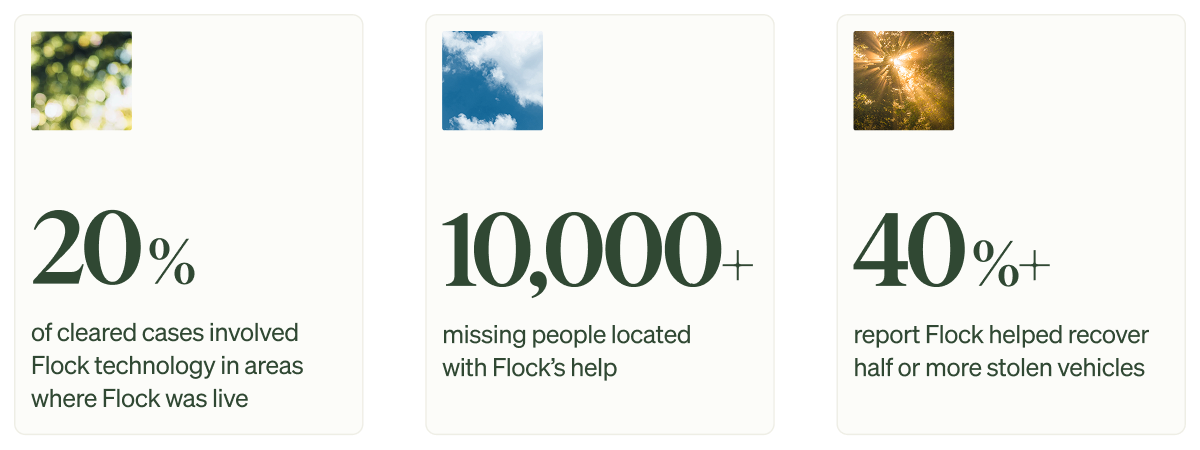
- In jurisdictions where Flock is deployed, an estimated 20% of solved cases were assisted with Flock technology.
- More than 10,000 missing persons were located last year with Flock’s help, totaling more than 27 per day.
- More than 40% of customers report that Flock was involved in recovering half or more of the stolen vehicles in their jurisdiction.
The 2025 Flock Impact Census: Methodology
Welcome to the first Flock Impact Census, which will be published annually.
Public conversation about police technology too often runs on anecdotes; high-profile success stories on one side, isolated misuse cases on the other. Neither makes for good policy nor good debate. As the largest deployer of this technology in the United States, we believe we have a responsibility to put structured evidence on the table, so that policymakers, journalists, and communities can argue from facts rather than assumptions, whether they support our work or criticize it.
Law enforcement agencies tell us that Flock is one of the most impactful crime-solving tools available. We hear it on customer calls, at conferences, and we see it in the news. We wanted to move beyond individual success stories and answer a bigger question: across all Flock customers, how much impact is the technology actually driving?
To find out, we sent a survey to our law enforcement customer agencies. The survey employed a two-phase branching design that allowed systematically tracked outcomes to be shared, as well as estimated Flock contributions. Agencies that formally track Flock-attributable outcomes reported raw counts. Agencies without formal tracking systems provided percentage estimates of Flock's contribution to their cleared cases. The figures below synthesize both groups.
With nearly 700 agencies representing communities of all sizes across 43 states, this is, to our knowledge, the largest study of police ALPR usage and outcomes ever conducted. We also ensured the responses were reflective of our full customer base by running appropriate statistical tests.1

How Often Does Flock Help Solve Crimes?
In communities where Flock is deployed, roughly 1 in 5 cases cleared by law enforcement involved Flock technology.
The majority of crimes reported to police go unsolved, but with Flock, we are changing that. We asked our customers what proportion of crimes are solved using Flock, and received hundreds of responses. We first examined the number of responses (n = 307) from agencies that estimated the proportion of crime they solved directly with Flock’s assistance.
Rather than simply averaging percentages given by agencies, we anchored every survey response to real-world crime and clearance data. Using the FBI's National Incident-Based Reporting System (NIBRS), we matched each responding agency's survey answers to their actual crime volumes and clearances for the prior year. This gives us an objective basis for assessing overall impact rather than relying on estimates alone. This approach ensures that a large department's 10% carries appropriately more weight than a small department's 10%. We then extrapolated the data across customers employing Flock to calculate the total impact.
The Result: Across communities where Flock is used, approximately 1 in 5 cases resolved by law enforcement involved Flock technology. This accounts for both serious incidents, including assault, robbery, motor vehicle theft, and homicide, as well as other crimes that occur. In addition, one-third of customers estimated that Flock assists them in solving 25% or more of their overall cases (n = 307).
How Many Missing Persons Does Flock Help Locate?
Conservative estimates show Flock technology helps law enforcement recover more than 10,000 missing persons each year in the U.S.
Missing persons cases are among the most urgent calls law enforcement handles. Every minute matters when someone is lost, vulnerable, or at risk of harm. Alert systems like AMBER Alerts and Silver Alerts help spread urgent information fast, but finding someone still depends on officers in the field having the right tools to act on that information.
To estimate what that looks like across all Flock customers, we projected the results from reporting agencies to the full customer base using two independent methods. The first applied a single, uniform per-capita rate (total missing persons found divided by total population served) across all customers. The second method recognized that agencies serving cities of different sizes may locate missing persons at different rates, so we computed separate rates for small, mid-size, and large cities and applied each rate only to customers in that same size group. The two methods produced estimates of approximately 9,900 and 11,900 missing persons found.
To test both figures, we used a bootstrap method, which recalculated each analysis 1,000 times, each time randomly reshuffling which agencies were included in the calculation. This standard statistical technique helps us understand how much the estimate might shift depending on which agencies are in the sample. The results consistently fell between 8,000 to 19,600, giving us confidence that the true number is within that range.
The Result: We conservatively estimate that Flock technology helps police locate approximately 10,000 missing persons per year in the US. That is the equivalent of finding 27 missing persons per day, more than 1 person per hour.

Flock and Stolen Vehicle Recovery
Motor vehicle theft is one of the most tangible and frustrating crimes a person can experience. For the victim, the loss isn't just financial; it significantly affects their quality of life. Furthermore, studies indicate that vehicle theft often serves as a precursor to additional criminal activity,2 highlighting the necessity of disrupting this pattern. For context, the national clearance rate for motor vehicle theft is 9.2% (FBI NIBRS, 2024), the lowest of any major crime category. With our technology, law enforcement is able to recover stolen vehicles quickly.
The Result: Descriptive statistics show that nearly half of our customers (42%) report that Flock was involved in recovering 50% or more of the stolen motor vehicles in their jurisdiction (n = 330). That figure spans agencies new to Flock and long-tenured customers alike. It highlights how Flock is frequently used to recover stolen vehicles while also finding weapons, contraband, and preventing future crimes from occurring.
What was Flock's 2025 Impact?
In 2025, we estimate that Flock technology supported law enforcement investigations in approximately 1 million cases nationwide.
Our survey found that Flock contributed to an estimated 20% of cleared cases in customer jurisdictions, on a weighted-average basis. However, solving a case is the end of an investigation, not the whole investigation. Officers routinely rely on Flock as part of active investigations, and our technology plays a role even when it is not the sole deciding factor in clearing a case.
We also found that more than 3 out of 4 Flock agencies assist neighboring departments at least monthly. When we account for the direct use of Flock in clearing a case, other cases where the technology was queried, cross-jurisdictional assists, and drone and other deployments, the estimate consistently comes to approximately 1 million cases.
We calculated this figure by starting with official FBI NIBRS data from 2024 and making several assumptions based on survey results and internal Flock data. These include estimated crime declines for 2025 and calculating the share of national crime volume in Flock customers' jurisdictions. These data were supplemented by estimates of the technology's role in overall solved and ongoing caseloads, as well as its contribution to investigations occurring in outside jurisdictions.3 Additionally, we leveraged internal Flock data on unique search volume that occurred in 2025 to support this figure, which was confirmed through multiple models.4 These figures are intended to show order-of-magnitude impact and should be read as directional estimates.
The estimate also aligns with the FBI’s recently released preliminary national crime data, which showed violent crime decreased an estimated 9.3% in 2025, including significant declines in murder, robbery, rape, and aggravated assault, according to the FBI’s First Look: 2025 Crime Data report.
This methodology is a starting point, not a finished product, and it will improve with each census. Researchers, statisticians, and policy experts: we want to hear your suggestions or critiques. Please email researchteam@flocksafety.com.
Frequently Asked Questions
What is the Flock Impact Census?
The Flock Impact Census is an annual study of how law enforcement uses Flock technology, — including ALPR cameras, drones, and Gunshot Detection, — and the public safety outcomes that result. The 2025 edition is the first in what will be a recurring annual program. With nearly 700 responding agencies serving communities across 43 states, it is, to our knowledge, the largest study of police ALPR usage and outcomes ever conducted.
Why is Flock publishing this report?
Public debate about police technology too often relies on anecdote rather than evidence. As the largest deployer of this technology in the United States, Flock believes it has a responsibility to put structured data on the table so that policymakers, journalists, and communities can argue from facts. The Impact Census will be published annually to support that conversation.
How was the data collected and validated?
The 2025 Impact Census surveyed Flock's law enforcement customer agencies using a two-phase branching design. Agencies that formally track Flock-attributable outcomes reported raw counts; agencies without formal tracking systems provided percentage estimates of Flock's contribution to their cleared cases. Results were anchored to FBI National Incident-Based Reporting System (NIBRS) crime and clearance data for each responding agency.
How many crimes does Flock help solve?
In jurisdictions where Flock is deployed, an estimated 20% of cleared cases in 2025 were assisted by Flock technology. Across all use cases, — direct case clearances, investigative leads, cross-jurisdictional assists, and field deployments, — Flock supported approximately 1 million investigations and incidents during the year.
How many missing persons does Flock help locate each year?
Flock technology helped law enforcement locate approximately 10,000 missing persons in 2025, — roughly 27 per day, or more than one per hour. The estimate is derived from two independent statistical methods that converged on the same range, with bootstrap testing producing a confidence range of 8,000 to 19,600. As this is the first annual Impact Census, the 2025 figure establishes a baseline; future editions will allow year-over-year tracking.
How effective is Flock at recovering stolen vehicles?
More than 40% of Flock customer agencies report that Flock technology was involved in recovering half or more of the stolen vehicles in their jurisdiction.
Does Flock benefit agencies that don't use the technology directly?
Yes. More than three out of four Flock customer agencies report assisting neighboring departments with Flock-derived information at least monthly, and one in five do so daily. This network effect extends Flock's investigative reach well beyond its direct customer base.
References
1 The sample closely matched the customer base on population-size distribution. Differences across population categories were small, and a goodness-of-fit test did not indicate a statistically meaningful departure from the customer-base distribution.
2 See, e.g., Robert D. Force, "Motor Vehicle Theft: A Relationship to Other Crimes," The Police Chief 83 (July 2016): 32–38.
3 Impact was calculated by applying an overall crime decline consistent with the FBI’s crime declines noted in its “First Look: 2025 Crime Data” release. We include Flock’s estimated 40%+ share of served crime volume, our survey results indicating a direct contribution to 20% of clearances in Flock agencies, and then added contributions from partner-assist and lead-only investigations, plus known outcomes like missing persons located. These figures are intended to show order-of-magnitude impact and should be read as directional estimates rather than audited totals.
4 The analysis applied empirically-derived reduction factors to actual Flock plate searches to estimate the share that represents actionable criminal-investigation queries. Reduction parameters were applied, including partial plate search rates, data entry error probabilities, eyewitness recall failure rates, and the traffic-versus-criminal split. The parameters were drawn from published research and industry data entry benchmarks.


Protect What Matters Most.
Discover how communities across the country are using Flock to reduce crime and build safer neighborhoods.