
.webp)






LPR Alert Management: How Agencies Reduce Noise Fast
See how LPR alert management improves response with risk-based triage, cleaner watchlists, better routing, and measures that reduce noise.

License plate reader (LPR) cameras give law enforcement agencies point-in-time vehicle evidence from public roadways, helping them understand when and where a vehicle was observed in a given area or jurisdiction.
But as agencies expand their systems past initial launch, alert fatigue becomes a real operational risk.
At a certain scale, LPR systems can generate more alerts than agencies can realistically work through. When this happens, responses slow down, priority vehicles get lost in the noise, and patrol teams begin to downplay or even ignore the system. Strong programs prioritize alerts that merit action and route them with context.
This article is for command staff seeking workflow solutions to LPR alert noise. By the end, you’ll have a practical framework for triage and prioritization, plus actionable guidance on placement, measurement, and governance.
Key Takeaways:
- Effective alert management for license plate reader cameras starts with prioritization, because treating every alert the same creates fatigue and slows response times.
- A strong triage workflow tiers alerts by risk, limits hotlists to priority vehicles, and audits stale entries.
- Before dispatch, agencies can improve alert quality by reviewing other recent detections, location, direction of travel, and related incidents for added operational context.
- Officer adoption, faster leads, reduced investigative time, and stronger case support measure alert management success more accurately than alert volume.
Why Alert Volume Becomes the Problem, Not the Solution
Law enforcement agencies with active LPR deployments set out to solve problems around visibility. But visibility loses its value without focus.
In other words, visibility only creates value when agencies can separate useful signals from operational noise. Not every vehicle that passes an LPR deployment or triggers an alert requires the same level of attention.
Without effective prioritization, LPR alerts become noise at scale. Responses slow, situational awareness weakens, and high-risk vehicle alerts can be missed. Unmanaged alerts create operational problems: dispatch bottlenecks, stale watchlists, and lower confidence and engagement from patrol.
The 5-Step Triage Workflow High-Performing Agencies Use
Successful agencies build workflows that surface the smaller set of alerts that actually require action. Effective agencies also add context, keep hotlists clean, and send alerts only to teams positioned to act.
The framework below is a five-step operating model for cutting down on alert noise. Command staff can adapt this model across patrol, investigations, dispatch, and the Real Time Crime Center.
Step 1: Categorize Alerts by Risk Tier Before Anything Else
Start by triaging alerts by severity and risk. High-risk vehicles should rise to the top; low-risk or unclear entries move to the bottom for analyst review.
By ranking alerts before dispatch, agencies reduce noise and protect dispatch capacity for alerts that need urgent or time-sensitive responses. Categorization may vary depending on agency priorities, but Tier 1 commonly includes stolen vehicles, vehicles tied to recent violent incidents, vehicles associated with active warrants, and vehicles connected to other time-sensitive investigations.
Other vehicles involved in recent incidents could be in Tier 1 or relegated to Tier 2, based on volume or priority.
Step 2: Limit Hotlists to Actionable Intelligence
Most agencies categorize alerts based at least in part on hotlists, making list hygiene a critical part of managing LPR alerts. Relying on broad or outdated hotlists introduces avoidable noise and directs patrol to lower-value alerts.
Keep a focused, actionable hotlist limited to vehicles that require immediate response. Each entry should include current case relevance and clear ownership, with a removal date set upfront to prevent stale entries from accumulating.
Step 3: Enrich Context Before Dispatching a Response
Before dispatching units to an LPR alert, enrich the alert with context: review recent vehicle detections, camera location, travel direction, and related incidents. When possible, send responders after human review and corroboration so they have clearer information about the vehicle, location, related case context, and possible risk.
Step 4: Route Alerts to the Right Role, Not the Whole Team
When alerts are not relevant to a person’s role, they become easier to ignore. The same is true in law enforcement. Patrol teams need immediate response alerts, while analysts need alerts that support pattern review and investigative context.
More than just a risk of clutter, whole-team notifications can lead to missed or delayed action. The person who needs to respond may not see the relevant notification because it’s sitting underneath a dozen other messages. Instead, use role-based routing to send specific alert types to the right roles:
- Immediate response alerts should route to patrol
- Follow-up leads should route to investigators
- Pattern review alerts should route to analysts
- Escalation and oversight alerts should route to supervisors
Step 5: Audit Hotlists Regularly to Remove Stale Entries
Hotlist hygiene is a two-part operating discipline. On the front end (Step 2), agencies must guard what they allow onto the hotlist, limiting lists to actionable entries.
On the back end (Step 5), agencies should establish a fixed review cadence for hotlist cleanup. Review the list for duplicate, expired, low-value, and unclear entries, then remove them (or relegate them to a lower-tier list). Governance matters here as well: documented search reasons, audit trails, and access controls can support oversight and defensibility when agencies review who added, changed, searched for, or acted on entries.
How Camera Placement Determines Alert Quality
LPR unit placement affects hit volume and the relevance of those hits, which creates a direct connection between camera placement and alert quality.
More cameras don’t automatically create better alerts. Cameras in low-value locations may increase volume without improving alert quality. Strategic placement helps agencies generate alerts with clearer operational relevance.
Instead of thinking in terms of camera numbers or locations, agencies seeking a practical LPR and video strategy should evaluate coverage gaps, like ingress points, arterial routes, corridors between hotspots, and places where investigations repeatedly lose sight of vehicles. Next, ask questions related to traffic patterns, investigative visibility, and operational coverage:
- Where are vehicles entering and exiting the jurisdiction?
- Which routes are often associated with vehicles tied to recent incidents?
- Which corridors connect areas with recurring calls for service or investigative activity?
- Where do investigations repeatedly lose visibility?
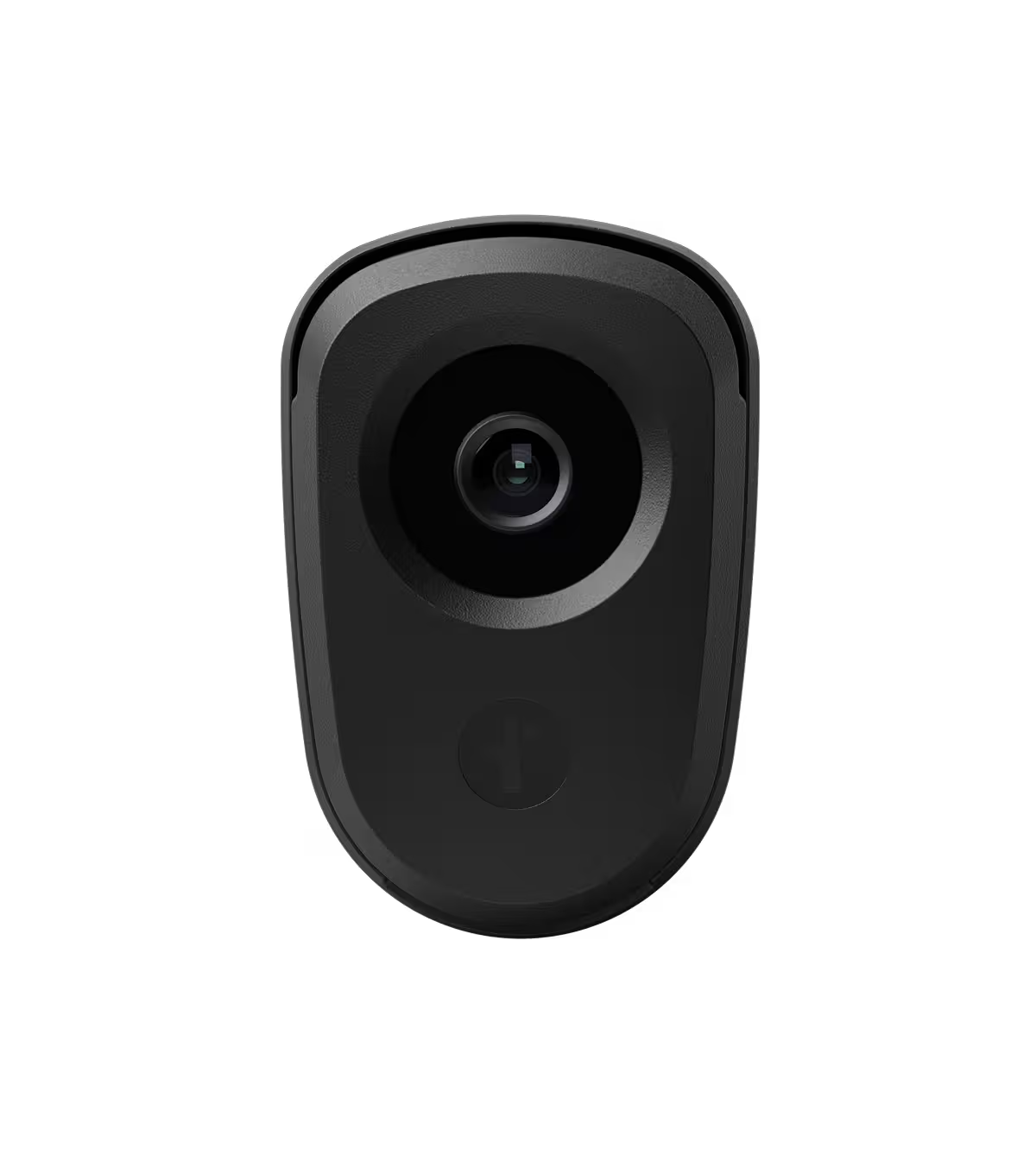
Flock offers solar-powered, infrastructure-free LPR systems that give agencies the flexibility to place cameras where coverage is needed. With Flock LPR, law enforcement can iterate to close coverage gaps instead of being limited by infrastructure or power requirements.
Measuring Whether Your Alert Management Is Actually Working
Alert counts and camera totals can be easy to report, but they don’t prove effectiveness on their own. If teams are still missing priority vehicle alerts or disengaging from the system, those metrics say little about the system’s effectiveness.
Success looks different over time as well. Over the first six months after adoption or major operational change, agencies should track operational adoption. Over the first year, the focus shifts to outcomes. Below are practical outlines for both timeframes.
Note: Command staff may also benefit from benchmark tables or checklists when evaluating workflow changes, expansions, or interoperability decisions.
What Success Looks Like at Six Months
Over the first six months, look for signals of operational adoption. Choose from this list as a starting point. Track the:
- Number of investigative leads
- Speed to suspect vehicle identification
- Number of stolen vehicle recoveries
- Officer usage rates
- Reduction of low-value alerts reaching patrol
Compare these against pre-implementation numbers to assess how well your agency is adopting the new LPR alert approach.
What Success Looks Like at Year One
At the end of year one, agencies should be able to evaluate outcomes, not just adoption. The metrics to measure include:
- Reduced investigative time
- Stronger cross-jurisdiction collaboration
- Better case support
- Public safety impact
Ultimately, agencies should look for clear evidence that vehicle data supports faster investigations, stronger collaboration, and more informed decisions.
A quick note on governance: Municipal rules around ALPR and related license plate recognition technologies continue to evolve rapidly. Build in an annual review of retention, sharing, and access policies that account for any changes in your jurisdiction(s).
Build a Smarter Alert Workflow and Put Your LPR Network to Work
An effective LPR program requires strategic infrastructure and disciplined workflows: prioritize coverage gaps over camera counts, keep hotlists clean, route alerts by role, and measure outcomes over volume.
In practice, that means fewer officers receiving irrelevant notifications, smarter triage from alert to dispatch, and measurement tied to case outcomes rather than alert counts.
Flock helps agencies connect LPR alerts, investigative tools, and real-time response workflows in one operating model. Flock’s solar-powered, LTE-enabled LPR cameras reduce reliance on existing power or network infrastructure. Book a demo.
FAQs
How do agencies manage alerts from license plate reader cameras at scale?
Effective agencies don't try to answer every alert. They tier alerts by risk, add context before dispatch, and send each alert to the team best positioned to act. Role-based access and audit logs also matter, especially as state and local retention rules continue to evolve.
What vehicles should be prioritized in watchlists?
High-priority hotlists usually start with stolen vehicles, vehicles associated with active warrants, vehicles tied to recent violent incidents, and other time-sensitive investigative needs. Lower-value entries should be reviewed often, because stale or broad lists create noise that slows response.
How do teams reduce false positives and alert fatigue?
Teams reduce false positives and alert fatigue by treating LPR reads as investigative leads that require human review and corroboration, tightening watchlists, and removing duplicate entries. Reviewing recent vehicle detections, location, and direction of travel before dispatch may help filter low-value hits.
How does camera placement affect alert quality?
Camera placement shapes alert quality because coverage gaps create missed opportunities, while redundant sites often add noise. Start with ingress points, arterial routes, hotspot connectors, and places where investigations repeatedly lose visibility. Each camera should answer a specific operational question, not just add more hardware.
How do you measure whether alert management is working?
At six months, look for operational adoption: consistent officer usage, more investigative leads, faster suspect vehicle identification, and stolen vehicle recoveries. by year one, stronger case support, shorter investigative timelines, and better regional collaboration usually matter more than alert volume.


Protect What Matters Most.
Discover how communities across the country are using Flock to reduce crime and build safer neighborhoods.