
.webp)







Warner Robins Police Department Closes the 911 Call Gap in Real Time
When an active 911 call involving an armed individual came in, Warner Robins officers received real-time caller audio and location through Flock911, arriving on scene before mutual aid was even requested.

The first minute of a 911 call is the most important.
While a caller describes a weapon, a suspect, or an address, officers in the field are still waiting. Waiting for the telecommunicator to relay details. Waiting for the dispatcher to get on the radio. Waiting for a compressed summary of a situation that was more urgent and more complex than a few words can capture. By the time a patrol unit knows what they're responding to, minutes may have already passed.
The time between when a 911 call is answered and when responders understand the nature and location of the incident is what Flock calls the 911 Call Gap. Flock911 was built to close it.
For the Warner Robins Police Department in Warner Robins, Georgia, the difference between the old and new ways played out in real time on a Monday night, with results that spoke for themselves.
The Incident: An Active 911 Call Reached Responders Before the Dispatch Request
The incident started as a training moment. A shift Lieutenant at Warner Robins PD was demonstrating Flock911 to one of his officers when a call alert appeared in OS Real Time from Houston County, near the city, and where Warner Robins units were already staged.
The call reported a fight, including one individual armed with a shotgun.
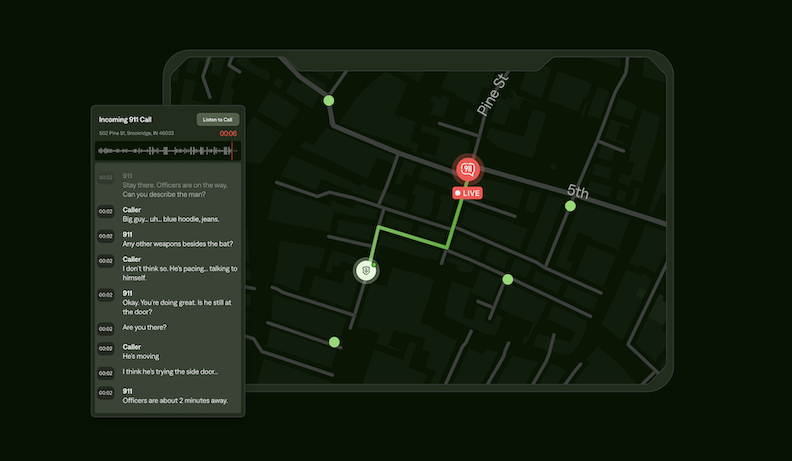
With Flock911 streaming live caller audio and location directly into OS Real Time, the Lieutenant could hear the call in real time. It was the same audio the 911 call taker was hearing, so the Lieutenant didn't need to wait for dispatch, read CAD notes, or wait for a clipped radio summary to have the full picture.
Recognizing the seriousness of the situation and the proximity of his unit, the Lieutenant made the decision to go toward the scene.
What happened next validated everything Flock911 is designed to do. As the Warner Robins unit arrived on scene, Houston County Dispatch requested assistance from the Warner Robins Police Department because no nearby deputy was available to respond.
Warner Robins was already there.
Their unit arrived on scene at precisely the moment the mutual aid request was being broadcast. Because of the advance notice Flock911 provided, they had moved before the official request was made, arrived faster, and were prepared for what was happening.
The Challenge: Critical Call Information Takes Time to Reach the Field
What happened in Warner Robins is a clear example of the 911 Call Gap costing agencies valuable time on active calls and of how Flock911 helps close the gap.
In a traditional CAD-and-radio workflow, information passes through several hands before it reaches a field officer: caller to call taker, call taker to a dispatcher in CAD, and then to patrol. Each step introduces a delay and compresses detail. An officer who finally hears about the call over the radio gets a nature code and an address, not the caller's tone, not the background noise, not the specific descriptor that could indicate the proper level of urgency, such as whether this is a domestic disturbance or a weapon in hand.
Flock911 removes the need to compress critical information into a few hurried words. It provides real-time 911 caller audio, transcripts, and caller location directly into OS Real Time, Flock Mobile, and Flock DFR, which are the same platforms officers, RTCC operators, SROs, and DFR pilots already use. The call taker continues working exactly as before, and dispatchers continue doing their jobs. Flock911 runs in parallel, delivering raw source intelligence to the field without changing a single workflow within the Emergency Communications Center.
Officers can start moving with context before dispatch goes out.
The Approach: Delivering Active 911 Intelligence Directly to Responders
Captain Eric Gossman of the Warner Robins Police Department has seen firsthand what this capability does for his department.
"Flock911 has become a force multiplier for the Warner Robins Police Department," said Captain Gossman. "By connecting our RTCC and patrol division with real-time intelligence the moment a call is received, our officers have greater situational awareness before they even arrive on scene. That early insight helps our responders make safer, faster, and more informed decisions, ultimately improving our ability to protect the community."
Warner Robins, like many agencies, faces the real-world constraint of finite resources: a limited number of units on shift, covering a defined geography. When one of those units can respond proactively to an incident in a neighboring jurisdiction after hearing the call live and self-dispatching before mutual aid was even requested, that's not just a good outcome for one call. It's a model for how agencies can do more with the resources they have.
It's also a demonstration of what's possible when real-time intelligence reaches the right people at the right time. In a situation involving a potentially armed individual, responders arrived with context about a weapon, the parties involved, and the location. Context supports safer decisions from the moment they arrive on scene.
The Outcome: Faster Response and Greater Situational Awareness
For agencies evaluating Flock911, the Warner Robins story illustrates several capabilities worth understanding:
Live caller audio and AI transcripts stream directly into OS Real Time, Flock Mobile, and Flock DFR the moment a call is received. Officers can listen in real time, scrub back to the beginning of a call they joined late, or replay calls for reporting and review.
Geolocation filtering routes relevant calls to the officers who need them, helping surface the right information at the right moment within each patrol zone or beat.
And because Flock911 lives on the same platform as LPR, video, and gunshot detection, a 911 call doesn't exist in isolation. It's plotted on the OS Real Time map alongside other alerts, giving RTCC operators and patrol supervisors a unified picture of an unfolding incident rather than a series of disconnected data points.
The Takeaway: Closing the 911 Call Gap Without Changing ECC Workflows
Agencies across the country have invested in CAD systems, radio infrastructure, and dispatch protocols built to support emergency response every day. Flock911 doesn’t replace those tools; rather, it adds a simple layer, delivering the caller's raw, unfiltered audio and real-time context directly to the people who need it most before the relay chain introduces delay.
In Warner Robins, the police department added Flock911 to its ECC workflow, and on a Monday night, a Lieutenant was already on scene when mutual aid was requested.
That's the 911 Call Gap—closed.
Learn more about Flock911 at flocksafety.com/products/flock911.


Protect What Matters Most.
Discover how communities across the country are using Flock to reduce crime and build safer neighborhoods.